
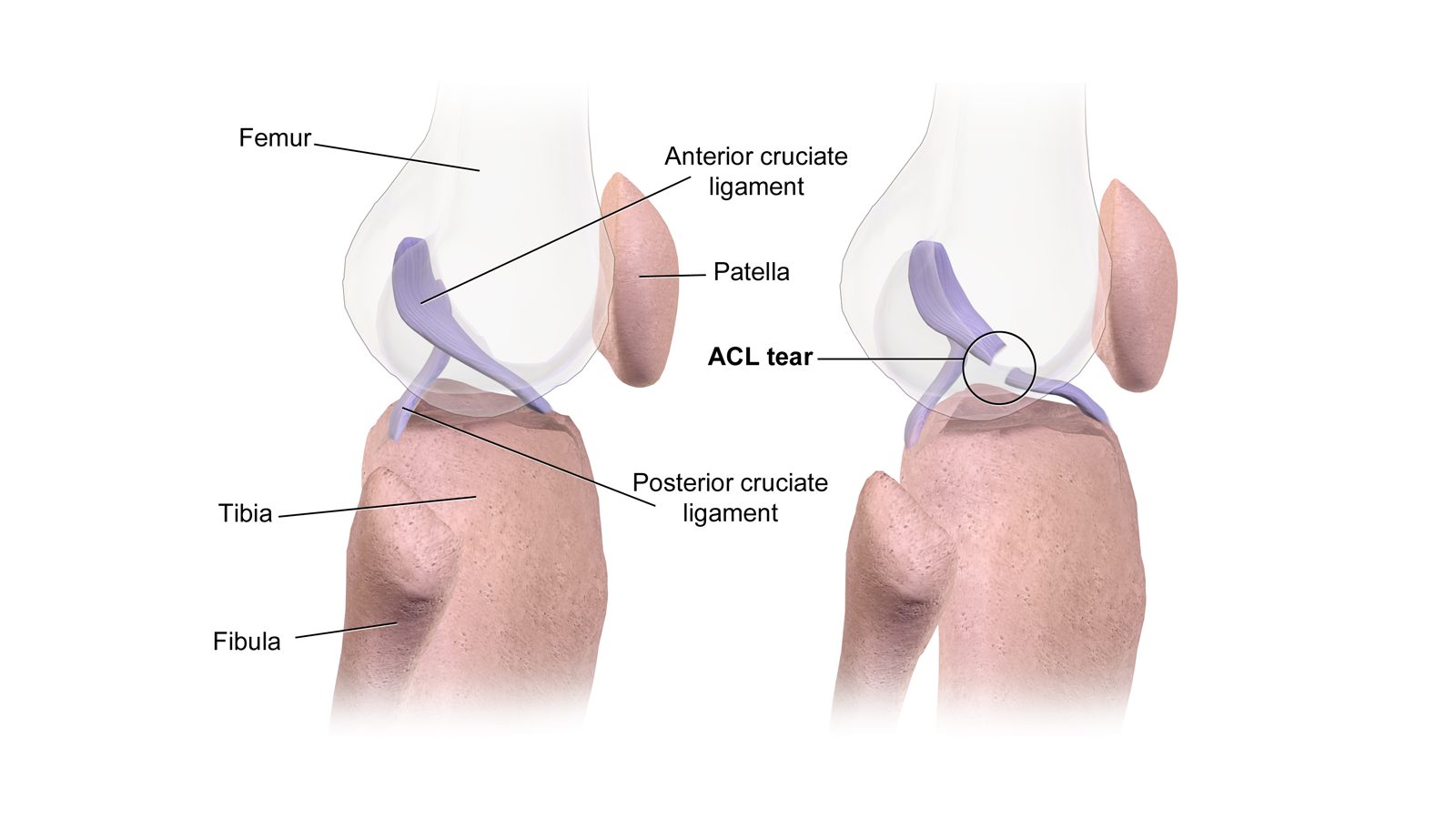
Torn ACL: What Your Grade Means and the Treatment It Needs
Rehabilitation, ultrasound-guided PRP and bone marrow concentrate, surgery when it is needed, and how to protect the knee for the years ahead.
A twist on a planted foot, a pop inside the knee, swelling within hours, and a knee that no longer feels steady: that is the typical anterior cruciate ligament (ACL) tear. Whether you need surgery depends on how badly the ligament is torn, whether the knee gives way in daily life, and what you need the knee to do. Just as important is protecting the knee from arthritis in the years that follow.
- 1 in 2young active adults treated with rehabilitation first never needed surgery1
- 30%of complete tears treated without surgery looked healed on MRI at 2 years2
- 95%of knee injections reached the target with ultrasound guidance, versus 82% without3
- 84%lower re-injury risk when return-to-sport tests were passed first4
The injury in brief
The ACL is a strong band in the centre of the knee that stops the shin bone sliding forward and twisting under the thigh bone. Most tears happen without contact, when landing, turning or stopping suddenly. The tear rarely comes alone: damage to the meniscus (the knee's shock absorber) and to the cartilage often comes with it, and these matter most for arthritis later.5 The ACL also heals more often than was once believed: 30% of complete tears treated with rehabilitation alone looked continuous on MRI two years later.2
How ACL tears are graded
| Grade | What has happened | How the knee feels and behaves |
|---|---|---|
| Grade I · Sprain | Fibres stretched; the ligament is intact. | Painful and swollen, but stable. |
| Grade II · Partial tear | Some fibres, or one of the ligament's two bundles, torn. | Some extra movement with a firm stop; turning and pivoting feel uncertain. |
| Grade III · Complete tear | The ligament is torn through. | Clear looseness; the knee may give way when turning. |
See an orthopaedic surgeon promptly if
The knee locks and will not straighten • you cannot put weight on it • the knee has dislocated or several ligaments are injured • the foot is numb or cold.
Our clinical pathway for an ACL tear
The plan is set by the grade, whether the knee gives way, the state of the meniscus and your goals. Rehabilitation runs through every step. Injections are placed under ultrasound guidance, so the needle can be watched reaching the torn ligament, and they support healing while the muscles are rebuilt, never in place of rehabilitation. Surgery is kept for the knee that needs it.
The stepwise pathway: what each step does and who it is for
| Step | What it does | Who it is for | What the evidence shows |
|---|---|---|---|
| Step 1 · Structured rehabilitationFoundation | Settles swelling and restores full straightening, then rebuilds the thigh muscles (with electrical muscle stimulation and blood-flow-restriction training), balance and landing control. | Every grade, from week one, before and after any procedure. Grade I usually needs nothing more. | With complete tears, rehabilitation first matched early surgery at 5 years, and about half never needed an operation.1 A second trial confirmed that half avoided surgery.6 |
| Step 2 · PRP under ultrasound guidanceEmerging | Platelets concentrated from your own blood release growth signals that draw repair cells to the injury. Under ultrasound they are placed into the torn part of the ligament itself. | Grade II partial tears with a stable knee, and Grade I sprains that are slow to settle. | Small studies: professional footballers with one bundle intact returned to their pre-injury level;7 a 42-patient series needed fewer reconstructions.8 Larger trials are awaited. |
| Step 3 · Bone marrow concentrate (BMAC) under ultrasound guidanceEmerging | Repair cells concentrated from your own bone marrow (drawn from the hip bone), combined with platelets and placed into the tear to support rebuilding of ligament tissue. | Grade II and selected Grade III tears whose torn ends have not pulled apart, without a major meniscal tear, in people who wish to avoid surgery. Recent tears respond best. | In a randomised trial against exercise therapy, knee function was better over 2 years9 and MRI showed improved ligament integrity; tears older than 12 months did less well.10 Data come mainly from one research group. |
| Step 4 · Arthroscopic ACL reconstructionEstablished | Keyhole replacement of the ligament with a tendon graft; a torn meniscus is repaired wherever possible. | A knee that still gives way after at least three months of good rehabilitation; return to pivoting sport; a repairable meniscal tear. | With ongoing instability, reconstruction gave better knee scores at 18 months than rehabilitation alone.11 |
| Throughout · Joint protectionFoundation | Muscle strength, control, tested return to sport, recovery support and nutrition, set out below. | ||
Swipe the table sideways to see every column.
Surgery restores stability, but on its own it does not prevent arthritis: about a third of people have knee arthritis around ten years after reconstruction.12 What protects the joint in the long run is what follows.
Protecting the knee for decades
An ACL injury raises the odds of later knee arthritis about seven-fold.12 Weak thigh muscles and excess body fat are two of the risks that can be changed,5 and they are the focus of this part of the programme.
| Focus | What we do | Why |
|---|---|---|
| Muscle strengthEstablished | Electrical muscle stimulation from week one; blood-flow-restriction training (light weights with a cuff on the thigh); progressive strength work. | Electrical stimulation improved thigh strength across 11 trials.13 Blood-flow-restriction training improved strength and pain without loosening the graft.14 |
| Control and a safe return to sportEstablished | Balance and landing training; return to pivoting sport only after strength and hop tests reach 90% of the other leg, and not before nine months after surgery. | Re-injury was 38% in those who failed these tests versus 6% in those who passed.4 Prevention training halves the risk of ACL injury.15 |
| PEMF after surgerySupportive evidence | Pulsed electromagnetic field therapy to calm joint inflammation in the first weeks after surgery. | In a double-blind trial, swelling settled and movement returned sooner, and fewer painkillers were needed; by two years results were similar.16 |
| Hyperbaric oxygen (HBOT)Under trial | Offered as an add-on to support graft healing, with a clear explanation that it is still being studied. | Improved graft healing in an animal study;17 a human randomised trial is under way.18 |
| Body and nutritionSupportive evidence | Weight, body fat, blood sugar (HbA1c), inflammation (hs-CRP) and vitamin D checked; protein-rich diet; gelatin (collagen) with vitamin C taken about an hour before rehabilitation sessions. | Excess body fat is a named arthritis risk.5 Gelatin with vitamin C before exercise doubled a blood marker of collagen production in a small study.19 |
Learn more about our sports injury and ACL care in Gurugram, physiotherapy and rehabilitation, PEMF therapy and hyperbaric oxygen therapy.
What your first assessment involves
- A stability examination of both knees: how far the shin moves, and whether the knee shifts on turning
- Ultrasound in the clinic and review of your MRI, to grade the tear and check the meniscus
- Thigh-muscle strength and balance measured, so every later step has a baseline
- Blood tests where relevant: sugar, inflammation and vitamin D
- A written plan stating your grade, your step on the pathway and when it will be reviewed
Points to remember
- Many ACL tears can be managed without surgery; the grade and whether the knee gives way decide.
- PRP and bone marrow concentrate, placed under ultrasound, support healing while the muscles are rebuilt; they do not replace rehabilitation.
- Surgery is the right step for a knee that keeps giving way or must return to pivoting sport.
- Strong thigh muscles, good control, a tested return to sport and a healthy body weight protect the knee for decades.
Written by Dr. Pirthi Singh Mann, Orthopaedic Surgeon (Trauma & Joint Replacement, Pain Management) and Longevity Consultant, founder of Mitogenez Longevity Clinic, Gurugram. For general education; reflects published research available as of November 2026. Not a substitute for consultation, examination or individual medical advice. Outcomes vary between individuals.
Cover illustration: ACL Tear by BruceBlaus, licensed under CC BY-SA 4.0, via Wikimedia Commons.
References
- Frobell RB, Roos HP, Roos EM, Roemer FW, Ranstam J, Lohmander LS. Treatment for acute anterior cruciate ligament tear: five year outcome of randomised trial. BMJ. 2013;346:f232. doi:10.1136/bmj.f232.
- Filbay SR, Roemer FW, Lohmander LS, et al. Evidence of ACL healing on MRI following ACL rupture treated with rehabilitation alone may be associated with better patient-reported outcomes: a secondary analysis from the KANON trial. Br J Sports Med. 2023;57(2):91-8. doi:10.1136/bjsports-2022-105473.
- Kasitinon D, Williams R, Peraka V, Ozcakar L, Jain NB. Accuracy and efficacy of intra-articular knee injections/aspirations under ultrasound versus landmark guidance: a systematic review. Am J Phys Med Rehabil. 2026;105(1):1-11. doi:10.1097/PHM.0000000000002803. PMID: 40729535.
- Grindem H, Snyder-Mackler L, Moksnes H, Engebretsen L, Risberg MA. Simple decision rules can reduce reinjury risk by 84% after ACL reconstruction: the Delaware-Oslo ACL cohort study. Br J Sports Med. 2016;50(13):804-8. doi:10.1136/bjsports-2016-096031. PMID: 27162233.
- Whittaker JL, Losciale JM, Juhl CB, et al. Risk factors for knee osteoarthritis after traumatic knee injury: a systematic review and meta-analysis of randomised controlled trials and cohort studies for the OPTIKNEE Consensus. Br J Sports Med. 2022;56(24):1406-21. doi:10.1136/bjsports-2022-105496. PMID: 36455966.
- Reijman M, Eggerding V, van Es E, et al. Early surgical reconstruction versus rehabilitation with elective delayed reconstruction for patients with anterior cruciate ligament rupture: COMPARE randomised controlled trial. BMJ. 2021;372:n375. doi:10.1136/bmj.n375. PMID: 33687926.
- Seijas R, Ares O, Cusco X, Alvarez P, Steinbacher G, Cugat R. Partial anterior cruciate ligament tears treated with intraligamentary plasma rich in growth factors. World J Orthop. 2014;5(3):373-8. doi:10.5312/wjo.v5.i3.373.
- Koch M, Mayr F, Achenbach L, et al. Partial anterior cruciate ligament ruptures: advantages by intraligament autologous conditioned plasma injection and healing response technique - midterm outcome evaluation. Biomed Res Int. 2018;2018:3204869.
- Centeno CJ, Lucas MD, Stemper I, Dodson E. Image guided injection of anterior cruciate ligament tears with autologous bone marrow concentrate and platelets: midterm analysis from a randomized controlled trial. Biol Orthop J. 2022;3(SP2):e7-e20. doi:10.22374/boj.v3isp2.24.
- Centeno CJ, Berger DR, Pitts J, et al. Non-surgical treatment of anterior cruciate ligament tears with percutaneous bone marrow concentrate and platelet products versus exercise therapy: a randomized-controlled, crossover trial with 2-year follow-up. BMC Musculoskelet Disord. 2025;26:882.
- Beard DJ, Davies L, Cook JA, et al. Rehabilitation versus surgical reconstruction for non-acute anterior cruciate ligament injury (ACL SNNAP): a pragmatic randomised controlled trial. Lancet. 2022;400(10352):605-15. doi:10.1016/S0140-6736(22)01424-6. PMID: 35988569.
- Webster KE, Hewett TE. Anterior cruciate ligament injury and knee osteoarthritis: an umbrella systematic review and meta-analysis. Clin J Sport Med. 2022;32(2):145-52. doi:10.1097/JSM.0000000000000894. PMID: 33852440.
- Li Z, Jin L, Chen Z, et al. Effects of neuromuscular electrical stimulation on quadriceps femoris muscle strength and knee joint function in patients after ACL surgery: a systematic review and meta-analysis of randomized controlled trials. Orthop J Sports Med. 2025;13(1):23259671241275071.
- Koc BB, Truyens A, Heymans MJLF, Jansen EJP, Schotanus MGM. Effect of low-load blood flow restriction training after anterior cruciate ligament reconstruction: a systematic review. Int J Sports Phys Ther. 2022;17(3):334-46. doi:10.26603/001c.33151.
- Webster KE, Hewett TE. Meta-analysis of meta-analyses of anterior cruciate ligament injury reduction training programs. J Orthop Res. 2018;36(10):2696-708. doi:10.1002/jor.24043. PMID: 29737024.
- Benazzo F, Zanon G, Pederzini L, et al. Effects of biophysical stimulation in patients undergoing arthroscopic reconstruction of anterior cruciate ligament: prospective, randomized and double blind study. Knee Surg Sports Traumatol Arthrosc. 2008;16(6):595-601. doi:10.1007/s00167-008-0519-9. PMID: 18385980.
- Leite CBG, Leite MS, Varone BB, et al. Hyperbaric oxygen therapy enhances graft healing and mechanical properties after anterior cruciate ligament reconstruction: an experimental study in rabbits. J Orthop Res. 2024;42(6):1210-22. doi:10.1002/jor.25787. PMID: 38225877.
- ClinicalTrials.gov. The effect of hyperbaric oxygen therapy for acceleration recovery after anterior cruciate ligament reconstruction (ACLR): a prospective, randomized control study. NCT06493851. Shamir Medical Center, Israel; recruiting.
- Shaw G, Lee-Barthel A, Ross MLR, Wang B, Baar K. Vitamin C-enriched gelatin supplementation before intermittent activity augments collagen synthesis. Am J Clin Nutr. 2017;105(1):136-43. doi:10.3945/ajcn.116.138594. PMID: 27852613.