
Recovery & orthopaedics
- Recovery after surgery or injury
- Slow-healing wounds and tissues
- Sports injuries
Hyperbaric oxygen therapy
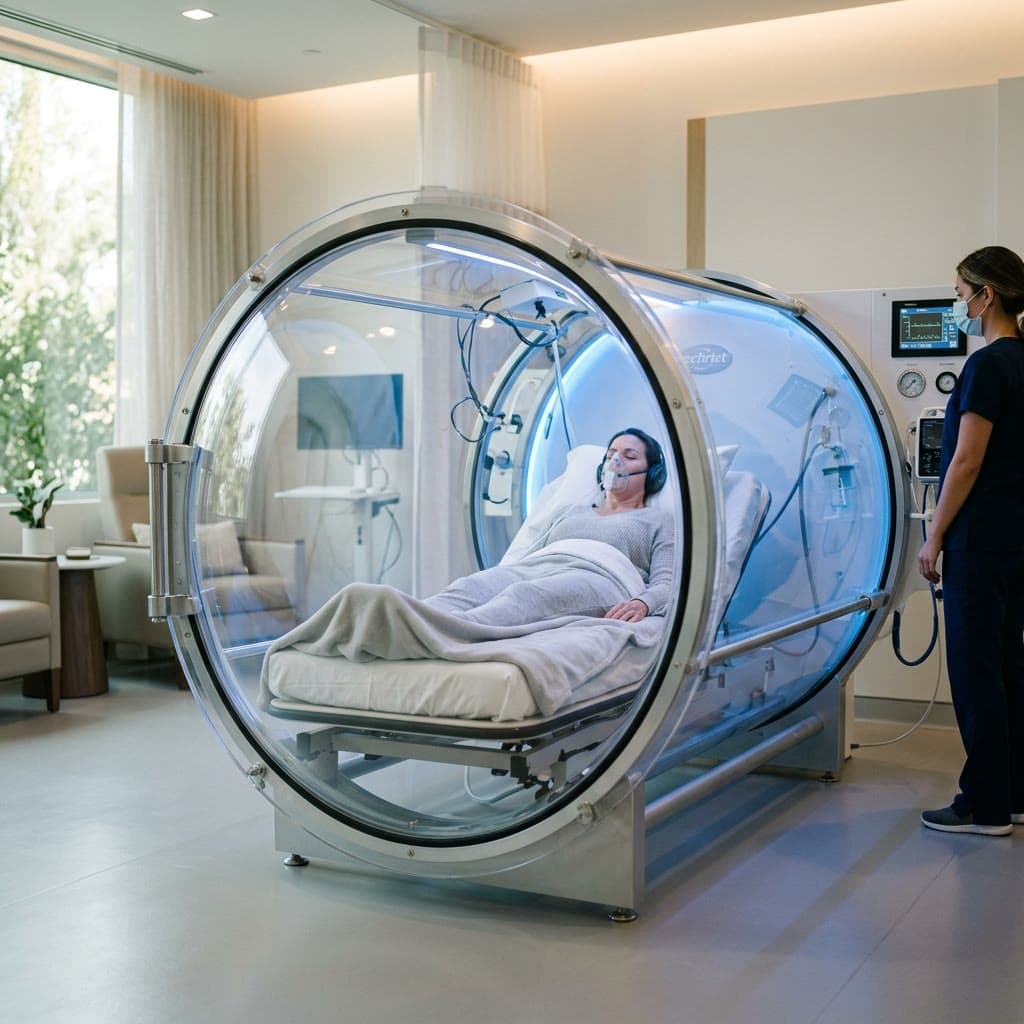
In a pressurised medical chamber you breathe concentrated oxygen, so far more of it dissolves into your blood and reaches tissues that are struggling to heal. At Mitogenez it supports a doctor-led plan; it is never the whole plan.
The idea
Normally, oxygen travels around your body attached to red blood cells. Where tissue is injured, inflamed or poorly supplied, too little of it gets through. Under pressure, oxygen also dissolves straight into the plasma, the liquid part of your blood, which reaches those areas more easily. That extra oxygen supports the body’s own repair.
How it works
The chamber is slowly pressurised, typically to around two to two and a half times normal air pressure (2–2.5 ATA).
You breathe near-pure oxygen, so many times more of it dissolves into your blood plasma than when breathing normal air.
Higher oxygen levels support healing processes, such as forming small new blood vessels in damaged tissue.
Your session
Session length
Typically 60–90 minutes
How it feels
Ear fullness, like a plane landing; you can rest, read or sleep
Course
A series of sessions, set and reviewed by your doctor
Before you start
A physician screens you for safety
Who it may help
Evidence differs by condition. Your doctor will tell you honestly how strong it is for your situation, and whether this therapy belongs in your plan at all.
Where it fits
HBOT works best as one part of a plan built around you. Your doctor first looks at what is holding back your recovery, treats the cause, and adds HBOT only where extra oxygen is likely to help, then checks the results.
Assess
A doctor reviews your health and screens you for safety.
Plan
Medicine and lifestyle first; therapies only where they help.
Measure
Retests show what is working, and the plan adapts.
Safety first
Questions
Most people find it calm. There are no needles. The main sensation is ear fullness while the pressure changes, like descending in a plane, which eases when you swallow. You can read, watch something or sleep, and you can speak to the team at any time.
Many spa chambers are soft, portable chambers that reach much lower pressures. Medical HBOT uses higher, controlled pressures with clinical supervision, which is the setting most research on HBOT is based on.
It varies with what you are treating. Some people notice better energy or sleep within a few weeks; tissue healing takes longer and depends on completing the course your doctor recommends. Your progress is reviewed rather than assumed.
In a properly screened and supervised setting, HBOT has a well-established safety record. It is not suitable for everyone, which is why a physician screens you first. Side effects, most often ear pressure, are usually mild and short-lived.
It depends on your goal. Your doctor recommends a course, reviews how you respond and adjusts it, rather than selling a fixed package up front.
Often combined with
A doctor looks at your whole health first, then decides with you whether HBOT belongs in your plan.