
Skin & hair
- Fine lines and skin texture
- Supporting wound and scar healing
- Hair thinning, alongside other treatment
Photobiomodulation
Red and near-infrared light, given at measured doses, is absorbed by your cells and may help support skin, recovery and joint comfort. At Mitogenez it supports a doctor-led plan; it is never the whole plan.
The idea
Your cells make energy in small structures called mitochondria. Certain wavelengths of red and near-infrared light are absorbed there, by an enzyme involved in making that energy. Research suggests this can nudge cells towards repair and calm some inflammation. The effect depends on getting the dose right, which is why it is set and reviewed by a doctor.
How it works
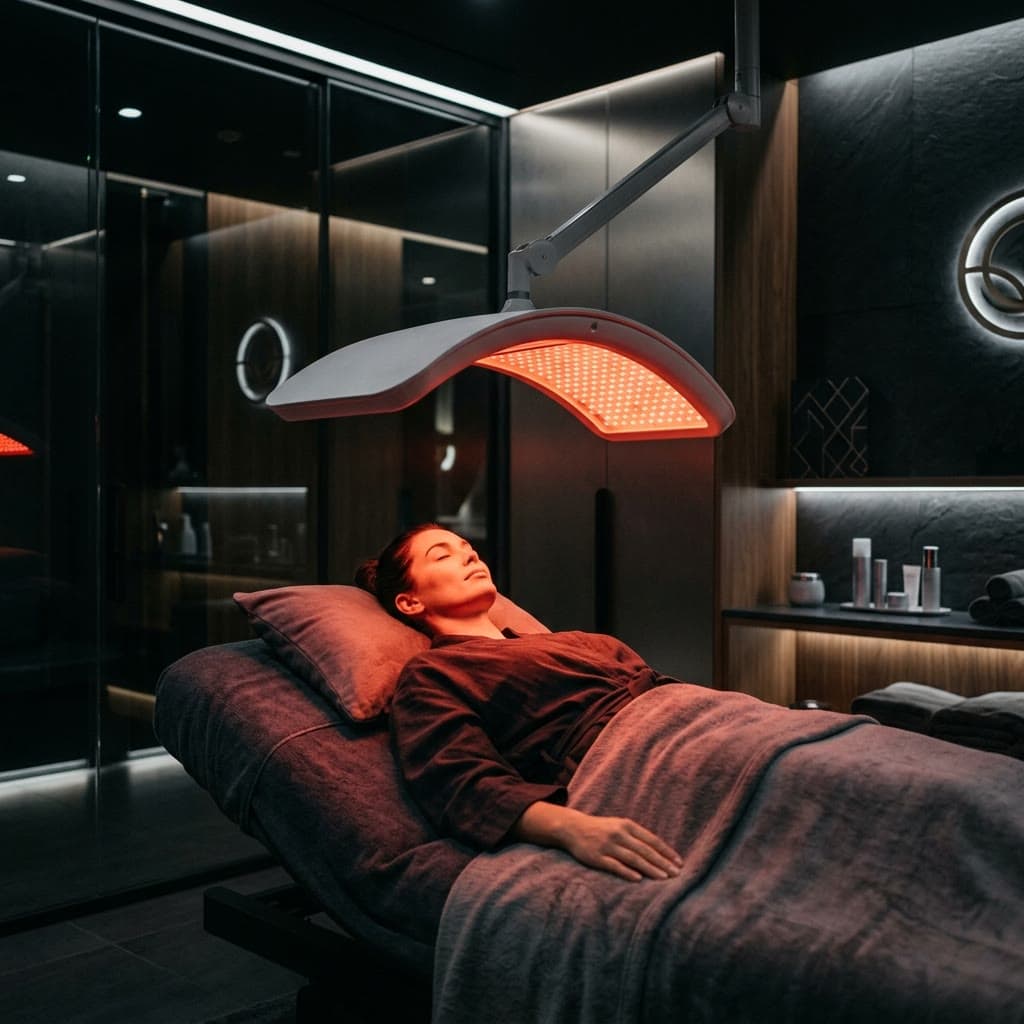
You rest under panels that give off specific red and near-infrared wavelengths. There is no UV, so it does not tan or burn the skin.
The light passes a short way into tissue and is absorbed by mitochondria, where it may support how cells produce energy.
Studies suggest this can support collagen production, tissue repair and lower local inflammation. Results vary from person to person.
Your session
Session length
Typically 10–20 minutes
How it feels
Mild, pleasant warmth; you wear protective eyewear
Course
Usually several sessions a week, set and reviewed by your doctor
Before you start
A physician screens you for safety
Who it may help
Evidence is strongest for some skin, hair and joint-pain uses, and still growing for others. Your doctor will tell you honestly how strong it is for your situation, and whether this therapy belongs in your plan at all.
Where it fits
Red light therapy works best as one part of a plan built around you. Your doctor first looks for the cause of your skin, pain or recovery concern and treats it, then adds red light only where it is likely to help, and checks the results over time.
Assess
A doctor reviews your health and screens you for safety.
Plan
Medicine and lifestyle first; therapies only where they help.
Measure
Retests show what is working, and the plan adapts.
Safety first
Questions
You can, and some home devices may help. Devices vary widely in wavelength and power, and many have not been tested. In clinic, the light and dose are chosen to match the ranges used in research, and a doctor decides whether it suits you and checks how you respond.
You lie or stand near the light wearing protective eyewear. Most people feel a mild, pleasant warmth and nothing more. There are no needles and no downtime, and many people simply rest.
There is reasonable evidence that red light can help some types of hair thinning, such as pattern hair loss. It is usually one part of a wider plan, sometimes alongside treatments like PRP, and results are gradual and vary between people.
In a screened, supervised setting it is generally very well tolerated. It has no UV and does not burn the skin. Your doctor checks for things that need care, such as light-sensitising medicines, eye conditions or a cancer in the treatment area, before you start.
It depends on your goal. Skin and hair changes usually take weeks to months of regular sessions. Your doctor recommends a course, reviews how you respond and adjusts it, rather than selling a fixed package up front.
Often combined with
A doctor looks at your whole health first, then decides with you whether red light therapy belongs in your plan.