
Training & recovery
- Muscle soreness after exercise
- Recovery between hard sessions
- Feeling refreshed after training
Cryotherapy
In cryotherapy you spend a few minutes in very cold, dry air. Many people use it to ease soreness and feel refreshed after training. At Mitogenez it supports a doctor-led plan; it is never the whole plan.
The idea
When your skin meets intense cold, your body reacts quickly. Blood vessels near the surface narrow to keep your core warm, then widen again once you warm up. The cold can also dull pain signals for a while and lift alertness and mood. Studies suggest it may ease muscle soreness and some joint pain, though results vary between people.
How it works
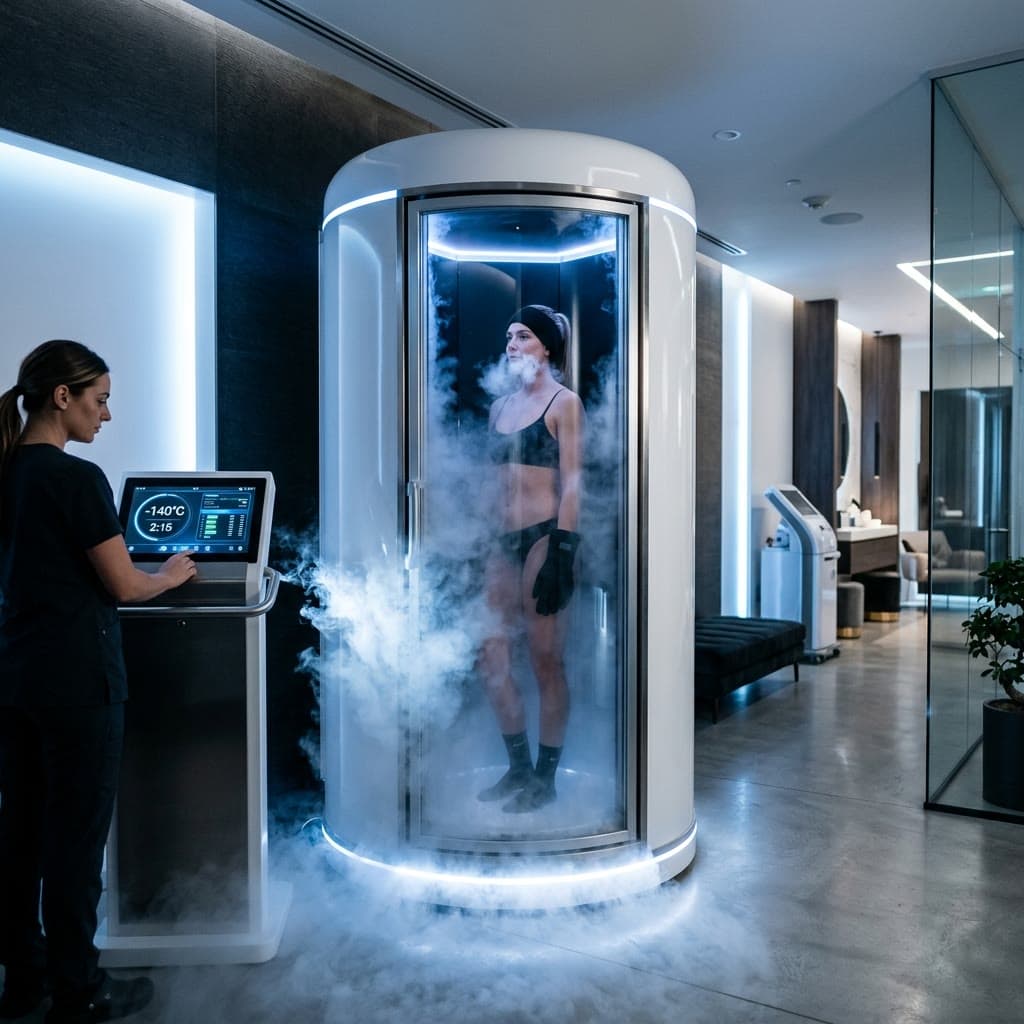
You stand in a chamber of very cold, dry air for a few minutes, wearing protective socks, gloves and other cover.
Your skin cools quickly while your core temperature stays close to normal. Blood vessels near the skin narrow.
As you rewarm, blood flow returns. Many people feel less sore and more alert, and some notice short-term pain relief.
Your session
Session length
Typically 2–3 minutes in the chamber
How it feels
Intense, bracing cold; staff talk with you throughout
Course
A series of sessions, set and reviewed by your doctor
Before you start
A physician screens you for safety
Who it may help
Evidence for cryotherapy is mixed: some studies show less soreness and pain for a while, others show little difference. Your doctor will tell you honestly what to expect, and whether it belongs in your plan at all.
Where it fits
Cryotherapy is a short, supportive tool, not a treatment for disease on its own. Your doctor first looks at what is driving your pain or slow recovery and treats it, then adds cold sessions only where they are likely to help, and reviews how you feel.
Assess
A doctor reviews your health and screens you for safety.
Plan
Medicine and lifestyle first; therapies only where they help.
Measure
Retests show what is working, and the plan adapts.
Safety first
Questions
It is intense and bracing rather than painful for most people. The air is dry, so it feels different from an ice bath. You wear protective socks and gloves, the session lasts only a few minutes, and staff talk with you the whole time. You can stop whenever you want.
You change into dry clothing with socks and gloves, step into the chamber and stay for a couple of minutes. Afterwards you move around gently to warm up. Many people feel alert and refreshed afterwards; some feel tired later in the day.
Some people feel less sore or more alert straight after a session, but this tends to be short-lived. For joint or long-term pain, any benefit usually needs a course of sessions and is not guaranteed. Your doctor reviews your progress rather than assuming it.
Often, yes. Your doctor may pair it with physiotherapy or other recovery therapies when that suits your goals. Timing matters, for example around strength training, so the order and spacing of sessions is set as part of your plan.
In screened, healthy adults with short, supervised sessions, serious problems are uncommon. Cold burns and blood pressure spikes are the main risks, which is why a physician screens you first, dry clothing is used, and sessions are carefully timed.
It depends on your goal. Some people use it occasionally after hard training; others try a short course for pain. Your doctor recommends a plan, reviews how you respond and adjusts it, rather than selling a fixed package up front.
Often combined with
A doctor looks at your whole health first, then decides with you whether cryotherapy belongs in your plan.