
Sciatica: The Right Treatment, at the Right Stage, in the Right Body
A stepwise pathway from physiotherapy to surgery, and why blood sugar, inflammation, vitamin D, bone density and muscle strength decide how well each step works.
A line of pain running from the buttock to the calf: that is sciatica, and the first question is almost always "Will I need surgery?" For most people the answer is no. The better questions are which treatment fits your disc and your stage, and whether your body is in a condition to heal.
- 6 in 10recovered within 3 months in a primary-care trial1
- ~70%of herniated discs shrink without surgery, mostly within 6 months2
- 2 to 3 in 10still have pain at one year and need a structured plan3
- 12 monthswhen surgery and non-surgical care give similar leg-pain results3
The condition in brief
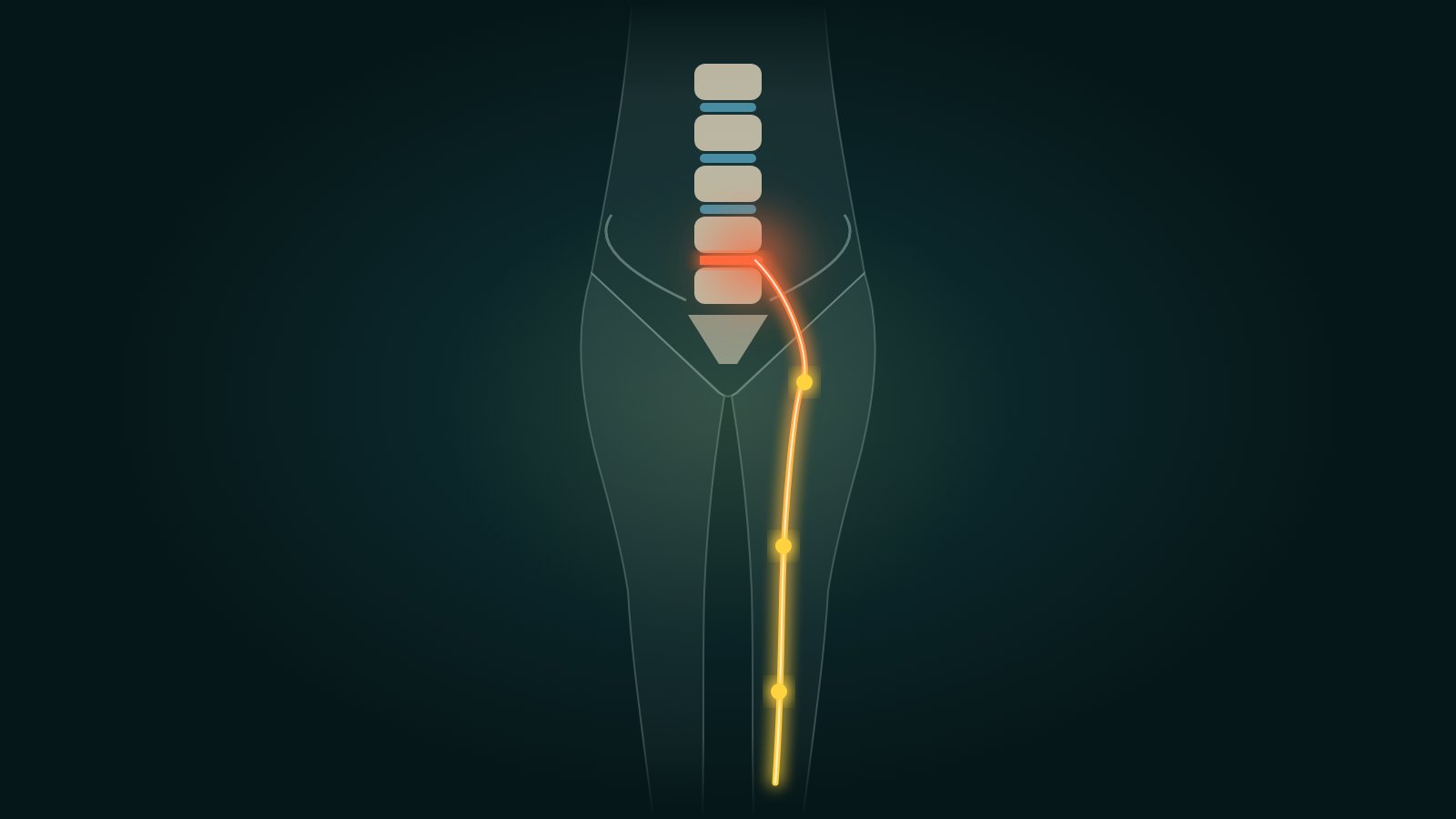
Sciatica is a symptom: a nerve root in the lower spine is pressed or chemically irritated, in 85 to 90% of cases by a slipped (herniated) disc.3 The type of disc problem guides treatment. A bulge or protrusion is contained, with the outer wall of the disc intact. An extrusion or sequestration has broken through the wall, and these ruptured discs are the ones the body most often absorbs and shrinks on its own.2 The MRI must also match the symptoms: disc bulges appear in 30% of pain-free 20-year-olds and 84% of pain-free 80-year-olds.4
Emergency signs: same-day hospital assessment
Loss of bladder or bowel control or difficulty passing urine • numbness around the genitals or anus • rapidly worsening leg weakness or foot drop • severe symptoms in both legs • fever, unexplained weight loss, history of cancer or major injury.5
Our clinical pathway for sciatica
Two principles shape every plan. First, step up only when the previous step has not done enough, and keep physiotherapy running through every step: blocks and injections exist to make strengthening possible, not to replace it. Second, treat the body around the disc from the first visit, because metabolic health, inflammation, bone and muscle influence how well every step works and whether the pain returns.
The stepwise pathway: what each step does and who it is for
| Step | What it does | Who it is for | What the evidence shows |
|---|---|---|---|
| Any stage · Emergency bypassUrgent | Skips the ladder entirely. | Bladder or bowel change, saddle numbness, progressive weakness or foot drop. | Urgent MRI and surgical decompression where compression is confirmed.5 |
| Step 1 · Physiotherapy and active rehabilitationFoundation | Directional (McKenzie-type) exercises, nerve gliding, core and hip stabilisation, then progressive strengthening. TENS or heat for comfort; short-term medicines only to allow sleep and movement. | Everyone without emergency signs, from week one. Continues through every later step and after recovery. | Early physiotherapy improved disability; 45% reported success at one year versus 28% with advice alone.6 Nerve gliding reduced pain across 20 trials.7 NICE advises against gabapentinoids, oral steroids and benzodiazepines,8 and pregabalin matched placebo.9 |
| Step 2 · Pain portal blocks + physiotherapyClinic practice | Small targeted injections at mapped points along the painful nerve pathway that quieten pain signalling. Their purpose is to open a window of reduced pain in which strengthening and nerve gliding can be done. | Pain severe enough in the first weeks to block sleep, walking or exercise. Used only alongside active rehabilitation: on their own, relief usually lasts a few days. | Based on established pain-gate physiology and clinical experience; not yet tested in large randomised trials. Its value lies in the rehabilitation it allows. |
| Step 3 · Image-guided selective nerve-root block or epidural injectionEstablished | Anti-inflammatory medicine placed beside the irritated nerve root under imaging; without imaging, up to 30% of epidural needles end up in the wrong place.10 Pulsed radiofrequency can be added if relief is short-lived; PRP where steroid is unsuitable. | Leg pain persisting at about 4 to 6 weeks despite steps 1 and 2, with an MRI that matches. Steroid exposure is kept low, especially with diabetes or low bone density. | Small short-term benefit, about 5 points on a 100-point scale.11 Pulsed radiofrequency added relief at 3 months (low certainty).12 Epidural PRP matched steroid in small trials.13 Steroid can raise blood sugar for about two days in diabetes,14 and repeated doses were linked to lower bone density.15 |
| Step 4 · Intradiscal ozone (ozone nucleolysis)Supportive evidence | An oxygen-ozone mixture injected into the disc under imaging to dehydrate the nucleus, reduce its volume and calm inflammation. Day-care procedure. | Contained disc only: a bulge or protrusion with no tear in the outer wall, still painful after steps 1 to 3. Not for extruded or free fragments, or progressive weakness. | Higher treatment success than steroid injection at 6 months or more in a 2024 meta-analysis.16 Trials are mostly against active treatments; no placebo-controlled trial was found in an earlier review.17 |
| Step 5 · Microdiscectomy or endoscopic discectomyEstablished | Removal of the disc fragment compressing the nerve, through a small incision or an endoscope. | Progressive weakness; or disabling pain beyond about 12 weeks with a matching MRI, especially an extruded or sequestrated fragment; or failure of earlier steps. | Faster relief: about 12 points better (0 to 100) in the first 3 months, 2 points at 12 months.3 After 4 to 12 months of sciatica, leg pain at 6 months was 2.8 with surgery versus 5.2 without.18 Endoscopic and open micro techniques gave similar results.19 |
| Throughout · Systemic recoveryFoundation | Runs alongside every step from the first visit: body weight and blood sugar, chronic inflammation, vitamin D and bone density, muscle strength, smoking. Set out in the next section. | ||
Swipe the table sideways to see every column.
On timing. Early surgery brings quicker relief, but the same result at one to two years as conservative care.20 Sciatica from canal narrowing or a slipped vertebra follows a separate pathway.
The body behind the disc: systemic recovery
A procedure can quieten an irritated nerve; whether the disc stays quiet depends on the body around it. Excess weight, poor blood-sugar control, smoking, low vitamin D, low bone density and weak spinal muscles are each linked, mostly in observational studies, to more sciatica, poorer recovery or more recurrence. That is why this work starts at the first visit and continues after the leg pain has gone.
| Factor | Why it matters for your spine | What we measure | What we address |
|---|---|---|---|
| Body weight and metabolic health | Overweight and obesity raise the risk of sciatica, and the risk climbs with weight (obesity: about 40% higher odds).21 Diabetes predicts a repeat disc slip after surgery,22 and steroid injections push blood sugar up for about two days.14 | Your weight, waist and body-fat percentage; HbA1c (three-month sugar average); fasting glucose and insulin (insulin resistance); lipid profile. | Structured nutrition and weight plan; correction of insulin resistance; diabetes brought under control before injections or surgery. |
| Chronic inflammation | Inflammation around the nerve root is a central pain mechanism. Higher hs-CRP was linked to poorer recovery after disc surgery in some studies,23 though not all.24 | Your hs-CRP (a sensitive blood marker of inflammation) and inflammation ratios from a routine blood count. | Anti-inflammatory dietary pattern, sleep restoration, stress regulation, and treatment of drivers found on testing. |
| Vitamin D and bone mineral density | Vitamin D deficiency affects an estimated 70 to 90% of Indians25 and is linked to low back pain (about 60% higher odds).26 Epidural steroids were linked to lower bone density in four of six studies,15 so bone health shapes how injections are planned. | Your 25-OH vitamin D and calcium; DEXA bone density if over 50, postmenopausal, after steroid courses, or after a low-trauma fracture. | Daily cholecalciferol dosed to your measured level, for bone and muscle health rather than as a pain cure; calcium and protein; bone-protective treatment if density is low; steroid exposure minimised. |
| Muscle strength and quality | Fatty replacement of the deep spinal muscles is linked to poorer recovery27 and more recurrence after disc surgery.28 Muscle is what protects the disc once the pain settles. | Your DEXA lean mass, grip strength, core and hip endurance tests; muscle quality on MRI. | Progressive resistance training for the core, glutes and back extensors; adequate protein; continued after recovery. |
| Smoking | Smoking roughly doubles the risk of a repeat disc slip after surgery.22 | Your smoking history. | Structured cessation support. |
Learn more about our sciatica and slip disc treatment in Gurugram, physiotherapy and rehabilitation, bone health and metabolic and weight care.
What your first assessment involves
- A nerve examination: leg strength, reflexes, sensation and the straight-leg-raise test
- Your MRI read against that examination, so treatment targets the level that is actually causing the pain
- Posture, core and hip strength measured, to set the physiotherapy plan and a baseline
- Blood tests where relevant (HbA1c, insulin, hs-CRP, vitamin D) and a bone density scan if indicated
- A written plan stating your step on the pathway and when it will be reviewed
Points to remember
- Most sciatica settles, and most herniated discs shrink, without surgery.
- Physiotherapy is the foundation; blocks and image-guided injections exist to make strengthening possible.
- The disc type on MRI guides the procedure, and bladder, bowel or strength changes are an emergency.
- Blood sugar, inflammation, vitamin D, bone density and muscle strength decide how well every step works and whether pain returns.
Written by Dr. Pirthi Singh Mann, Orthopaedic Surgeon (Trauma & Joint Replacement, Pain Management) and Longevity Consultant, founder of Mitogenez Longevity Clinic, Gurugram. For general education; reflects published research available as of November 2026. Not a substitute for consultation, examination or individual medical advice. Outcomes vary between individuals.
References
- Koes BW, van Tulder MW, Peul WC. Diagnosis and treatment of sciatica. BMJ. 2007;334(7607):1313-7. doi:10.1136/bmj.39223.428495.BE.
- Zou T, Liu XY, Wang PC, et al. Incidence of spontaneous resorption of lumbar disc herniation: a meta-analysis. Clin Spine Surg. 2024;37(6):256-69. doi:10.1097/BSD.0000000000001490. PMID: 37559207.
- Liu C, Ferreira GE, Abdel Shaheed C, et al. Surgical versus non-surgical treatment for sciatica: systematic review and meta-analysis of randomised controlled trials. BMJ. 2023;381:e070730. doi:10.1136/bmj-2022-070730. PMID: 37076169.
- Brinjikji W, Luetmer PH, Comstock B, et al. Systematic literature review of imaging features of spinal degeneration in asymptomatic populations. AJNR Am J Neuroradiol. 2015;36(4):811-6. doi:10.3174/ajnr.A4173. PMID: 25430861.
- Jensen RK, Kongsted A, Kjaer P, Koes B. Diagnosis and treatment of sciatica. BMJ. 2019;367:l6273. doi:10.1136/bmj.l6273.
- Fritz JM, Lane E, McFadden M, et al. Physical therapy referral from primary care for acute back pain with sciatica: a randomized controlled trial. Ann Intern Med. 2021;174(1):8-17. doi:10.7326/M20-4187. PMID: 33017565.
- Lin LH, Lin TY, Chang KV, Wu WT, Ozcakar L. Neural mobilization for reducing pain and disability in patients with lumbar radiculopathy: a systematic review and meta-analysis. Life (Basel). 2023;13(12):2255. doi:10.3390/life13122255. PMID: 38137856.
- National Institute for Health and Care Excellence. Low back pain and sciatica in over 16s: assessment and management. NICE guideline NG59. London: NICE; 2016 (updated 2020). Available from: https://www.nice.org.uk/guidance/ng59
- Mathieson S, Maher CG, McLachlan AJ, et al. Trial of pregabalin for acute and chronic sciatica. N Engl J Med. 2017;376(12):1111-20. doi:10.1056/NEJMoa1614292. PMID: 28328324.
- White AH, Derby R, Wynne G. Epidural injections for the diagnosis and treatment of low-back pain. Spine (Phila Pa 1976). 1980;5(1):78-86.
- Oliveira CB, Maher CG, Ferreira ML, et al. Epidural corticosteroid injections for lumbosacral radicular pain. Cochrane Database Syst Rev. 2020;4:CD013577. doi:10.1002/14651858.CD013577.
- Park S, Park JH, Jang JN, et al. Pulsed radiofrequency of lumbar dorsal root ganglion for lumbar radicular pain: a systematic review and meta-analysis. Pain Pract. 2024;24(5):772-85. doi:10.1111/papr.13351. PMID: 38294072.
- Muthu S, Viswanathan VK, Gangadaran P. Is platelet-rich plasma better than steroids as epidural drug of choice in lumbar disc disease with radiculopathy? Meta-analysis of randomized controlled trials. Exp Biol Med (Maywood). 2025;250:10390. doi:10.3389/ebm.2025.10390.
- Even JL, Crosby CG, Song Y, McGirt MJ, Devin CJ. Effects of epidural steroid injections on blood glucose levels in patients with diabetes mellitus. Spine (Phila Pa 1976). 2012;37(1):E46-50.
- Kerezoudis P, Rinaldo L, Alvi MA, et al. The effect of epidural steroid injections on bone mineral density and vertebral fracture risk: a systematic review and critical appraisal of current literature. Pain Med. 2018. PMID: 29304236.
- Chang MC, Choo YJ, Denis I, et al. Effectiveness of intradiscal ozone injections for treating pain following herniated lumbar disc: a systematic review and meta-analysis. J Back Musculoskelet Rehabil. 2024;37:1131-9. doi:10.3233/BMR-240024. PMID: 38905033.
- Magalhaes FN, Dotta L, Sasse A, Teixeira MJ, Fonoff ET. Ozone therapy as a treatment for low back pain secondary to herniated disc: a systematic review and meta-analysis of randomized controlled trials. Pain Physician. 2012;15(2):E115-29. PMID: 22430658.
- Bailey CS, Rasoulinejad P, Taylor D, et al. Surgery versus conservative care for persistent sciatica lasting 4 to 12 months. N Engl J Med. 2020;382(12):1093-102. doi:10.1056/NEJMoa1912658. PMID: 32187469.
- Meyer G, da Rocha ID, et al. Percutaneous endoscopic lumbar discectomy versus microdiscectomy for the treatment of lumbar disc herniation: pain, disability, and complication rate - a randomized clinical trial. Int J Spine Surg. 2020;14(1):72-8. doi:10.14444/7010.
- Peul WC, van Houwelingen HC, van den Hout WB, et al. Surgery versus prolonged conservative treatment for sciatica. N Engl J Med. 2007;356(22):2245-56. doi:10.1056/NEJMoa064039.
- Shiri R, Lallukka T, Karppinen J, Viikari-Juntura E. Obesity as a risk factor for sciatica: a meta-analysis. Am J Epidemiol. 2014;179(8):929-37. doi:10.1093/aje/kwu007. PMID: 24569641.
- Huang W, Han Z, Liu J, Yu L, Yu X. Risk factors for recurrent lumbar disc herniation: a systematic review and meta-analysis. Medicine (Baltimore). 2016;95(2):e2378. doi:10.1097/MD.0000000000002378. PMID: 26765413.
- Sugimori K, Kawaguchi Y, Morita M, Kitajima I, Kimura T. High-sensitivity analysis of serum C-reactive protein in young patients with lumbar disc herniation. J Bone Joint Surg Br. 2003;85(8):1151-4.
- Elkan P, Sten-Linder M, Hedlund R, et al. Markers of inflammation and fibrinolysis in relation to outcome after surgery for lumbar disc herniation. Eur Spine J. 2016;25(1):186-91. doi:10.1007/s00586-015-3998-7. PMID: 25962814.
- Selvarajan S, Gunaseelan V, Anandabaskar N, et al. Systematic review on vitamin D level in apparently healthy Indian population and analysis of its associated factors. Indian J Endocrinol Metab. 2017;21(5):765-75.
- Zadro J, Shirley D, Ferreira M, et al. Mapping the association between vitamin D and low back pain: a systematic review and meta-analysis of observational studies. Pain Physician. 2017;20(7):611. doi:10.36076/ppj/2017.7.611.
- Santos JCC, et al. Relationship between fatty infiltration of paraspinal muscles and clinical outcome after lumbar discectomy. Brain Spine. 2022;2:101697. doi:10.1016/j.bas.2022.101697.
- Sun K, Qin R, Wang W, et al. Multifidus fat infiltration negatively influences the postoperative outcomes in lumbar disc herniation following transforaminal approach percutaneous endoscopic lumbar discectomy. Eur J Med Res. 2025;30(1):47. doi:10.1186/s40001-025-02283-2.