
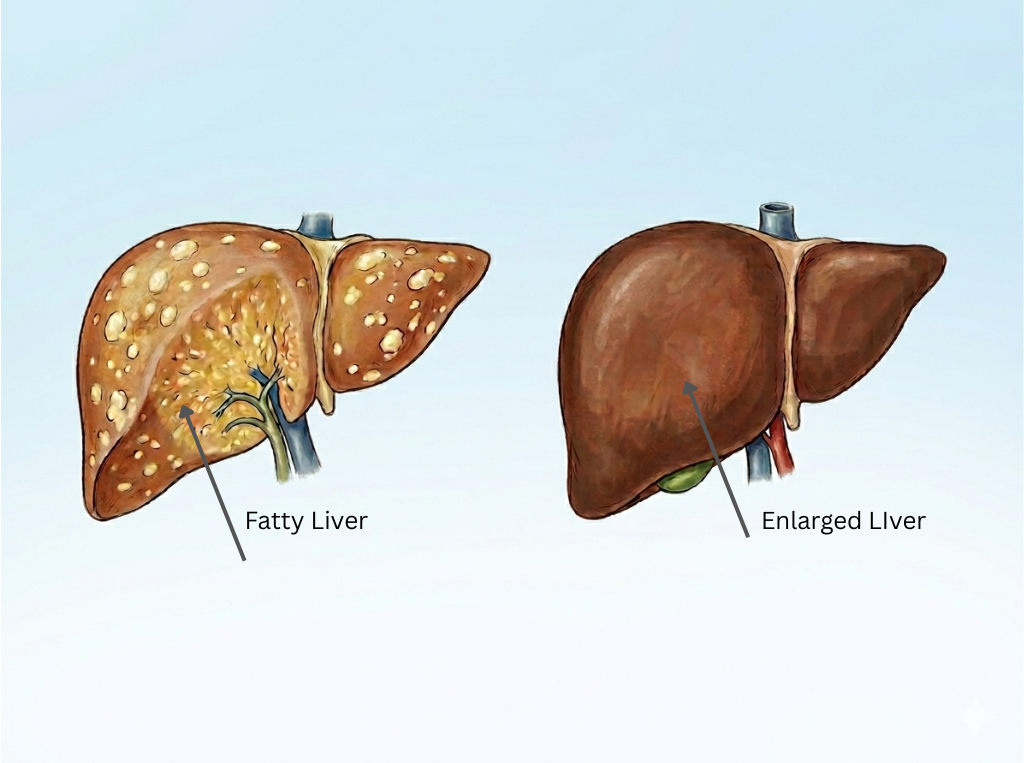
Fatty Liver vs Enlarged Liver: Understanding the Real Difference and What It Means for Your Health
Liver related concerns are increasingly being detected during routine health checks, often leaving individuals confused between terms such as fatty liver and enlarged liver. While they are frequently…
Liver related concerns are increasingly being detected during routine health checks, often leaving individuals confused between terms such as fatty liver and enlarged liver. While they are frequently used interchangeably, they do not mean the same thing. In fact, an enlarged liver is not a disease in itself but a clinical sign that may arise from multiple underlying conditions, including fatty liver.
Understanding this distinction is important, as it shifts the focus from simply identifying a symptom to addressing the root cause behind it. At Mitogenez, this distinction is central to how liver health is evaluated and managed, ensuring that treatment is directed towards the underlying imbalance rather than just visible changes.
This article explores the science behind both conditions, their causes, risks and how they differ, helping build a clearer and more informed perspective.
Healthy liver
A healthy liver maintains a delicate internal balance that supports multiple essential functions in the body. It processes nutrients, regulates metabolism, detoxifies harmful substances and plays a key role in immune function.
In its normal state, the liver contains a small amount of fat, typically less than 5 percent of its total weight. It also maintains a consistent size, smooth texture and optimal blood flow.
When this balance is disturbed, structural and functional changes begin to appear, often silently.
Fatty liver (steatosis liver disease)
Fatty liver, medically referred to as steatosis liver disease (SLD), occurs when excess fat accumulates within liver cells. This is not merely a storage issue but a reflection of altered metabolic processes within the body.
When fat begins to exceed normal limits, it interferes with cellular function, affecting how the liver processes nutrients and toxins. Over time, this can lead to inflammation and further complications.
At Mitogenez, fatty liver is understood as a manifestation of deeper metabolic dysfunction rather than an isolated liver condition.
Enlarged liver
An enlarged liver, also known as hepatomegaly, refers to an increase in the size of the liver beyond its normal limits. It is not a disease but a physical finding that indicates an underlying issue.
This enlargement may occur due to fat accumulation, inflammation, infection, congestion or tumour related changes. The liver may feel swollen or heavier and in some cases, it can be detected during physical examination or imaging tests.
It is important to recognise that fatty liver is one of the most common causes of an enlarged liver, but not the only one.
Difference between fatty liver and enlarged liver
| Aspect | Fatty Liver | Enlarged Liver (Hepatomegaly) |
|---|---|---|
| Definition | A medical condition caused by fat buildup in liver cells. | A condition where the liver becomes larger than normal. |
| Meaning | Excess fat stored inside liver cells. | Increase in liver size beyond normal limits. |
| Nature | A specific diagnosed disease. | A general condition requiring further diagnosis. |
| Relation | May lead to liver enlargement over time. | Can occur without fat accumulation. |
| Primary Causes | Obesity, poor diet, alcohol, metabolic issues. | Infections, heart disease, inflammation, tumors. |
| Clinical Insight | Shows metabolic imbalance. | Indicates underlying health issues. |
Causes
Understanding the causes of fatty liver and an enlarged liver is essential to identify the underlying imbalance rather than just the visible outcome.
While fatty liver develops through metabolic dysfunction, an enlarged liver can arise from a wider range of conditions. This distinction helps guide accurate diagnosis and targeted management.
Fatty liver is primarily driven by internal metabolic disturbances that affect how the body processes and stores fat. These changes develop gradually and often go unnoticed in the early stages. Over time, they create a sustained burden on liver function.
Key contributing factors include:
- Insulin resistance leading to fat deposition
- Obesity and excess visceral fat
- High sugar and processed food intake
- Sedentary lifestyle
- Chronic inflammation
- Hormonal imbalance
These factors interact and reinforce each other, creating a cycle of metabolic stress.
An enlarged liver reflects a response to various underlying conditions rather than a single cause. It may develop due to structural changes, inflammation or external factors affecting liver health. Identifying the exact cause is essential for appropriate care.
Common causes include:
- Fatty liver disease
- Alcohol related liver damage
- Viral infections such as hepatitis
- Congestive heart conditions
- Liver tumours or cysts
This shows that enlargement is a broader indicator rather than a single condition.
Risk factors
The risks associated with fatty liver and an enlarged liver depend on progression and underlying causes. While fatty liver tends to follow a metabolic pathway, the risks of an enlarged liver vary significantly based on what is driving the enlargement.
If left unaddressed, fatty liver can progress through different stages, each carrying increasing health implications. These risks extend beyond the liver and affect overall metabolic health.
- Progression to inflammation and fibrosis
- Increased risk of cirrhosis
- Association with cardiovascular disease
- Higher likelihood of diabetes
The risks of an enlarged liver are not fixed and depend entirely on its underlying cause. It may represent anything from a reversible condition to a serious health concern requiring timely attention.
- Depends on underlying cause
- May indicate serious conditions such as hepatitis or cancer
- Can lead to impaired liver function if untreated
The risk profile of an enlarged liver varies widely, making diagnosis essential.
Symptoms
Symptoms of both conditions often overlap, which can make early identification challenging. Fatty liver tends to remain silent initially, whereas an enlarged liver may produce more noticeable physical discomfort. Recognising subtle changes can support earlier intervention.
Fatty liver often progresses quietly, with symptoms appearing only when the condition advances. These signs are usually mild and easily overlooked.
- Often silent in early stages
- Persistent fatigue
- Mild discomfort in the right abdomen
- Metabolic disturbances
An enlarged liver is more likely to produce physical sensations due to increased size and pressure within the abdomen. These symptoms may vary depending on severity and cause.
- Abdominal fullness or heaviness
- Pain or discomfort on the right side
- Nausea or loss of appetite
- Jaundice in advanced cases
Symptoms often overlap, which is why differentiation requires proper evaluation.
Spleen and its relevance
In advanced liver conditions, the spleen may also become enlarged, a condition known as splenomegaly. This usually occurs due to increased pressure in the liver’s blood circulation.
An enlarged spleen can indicate progression of liver disease, particularly in later stages such as fibrosis or cirrhosis. It reflects how liver dysfunction can extend beyond a single organ and affect the entire system and overall physiological balance of the body.
Fatty liver or Enlarged liver: Which is more dangerous?
Fatty liver and enlarged liver cannot be directly compared in terms of severity because they represent different aspects of liver health.
- Fatty liver is dangerous when it progresses silently over time.
- Enlarged liver is concerning because it may signal an underlying serious condition.
The real concern lies in what is causing these changes rather than the label itself. Both conditions can become critical if left unaddressed.
- Fatty liver may progress to steatohepatitis, fibrosis and cirrhosis.
- An enlarged liver due to severe causes may indicate liver failure or malignancy.
Early detection and intervention are crucial in preventing irreversible damage.
How to Manage fatty and enlarged liver?
There is no single universal cure, but both conditions can be managed and often reversed when addressed early and correctly.
- Restoring metabolic balance
- Improving insulin sensitivity
- Adopting structured nutrition
- Increasing guided physical activity
- Addressing underlying causes such as infection or alcohol intake
At Mitogenez Longevity Clinic, the approach goes beyond symptom management. It focuses on identifying the root cause through detailed evaluation and creating a personalised plan that integrates nutrition, targeted therapies and lifestyle correction.
This structured approach helps not only reduce fat accumulation but also restore liver function and overall metabolic health.
Additionally, Mitogenez emphasises continuous monitoring and adaptive care, ensuring that improvements are sustained over time rather than temporary.
Conclusion
Fatty liver and enlarged liver are closely related yet fundamentally different. One represents a condition driven by metabolic imbalance, while the other is a sign pointing towards an underlying issue. Confusing the two can delay proper diagnosis and treatment.
A deeper understanding allows for more precise action, shifting the focus from surface level findings to root cause correction and long-term balance.
At Mitogenez, this philosophy is central to care. By addressing the underlying drivers of liver dysfunction and not just the visible changes, individuals are guided towards long-term recovery, improved vitality and sustained health.
Disclaimer:
This content is for general informational purposes only and does not constitute medical advice, diagnosis or treatment. Always consult a qualified healthcare professional with any questions regarding a medical condition or health objective.